Heavy Equipment & CSA Compliance
Beyond the Ignition: The Manager’s Guide to Heavy Equipment and CSA Compliance
The Legal DNA of Your Fleet: Heavy Equipment as a Regulated Asset
In the Canadian industrial landscape, a piece of heavy equipment is more than a mechanical tool—it is a regulated asset. Whether it’s an excavator in a BC forest or a reach truck in an Ontario warehouse, the “right to operate” hinges on engineering standards often invisible to the naked eye.
For fleet managers, understanding CSA certifications isn’t just about safety; it’s about due diligence. This is your primary legal defense, proving you took every reasonable precaution to protect workers and comply with provincial OHS acts.
The Gold Standard: Understanding CSA Compliance in Canada
Unlike many international jurisdictions that rely solely on manufacturer claims, Canada adheres to the CSA Group (Canadian Standards Association).
Why CSA Standards Matter
Even if a machine is built in the US or Europe, it must meet specific Canadian “Z-series” or “B-series” standards to be compliant on a jobsite.
-
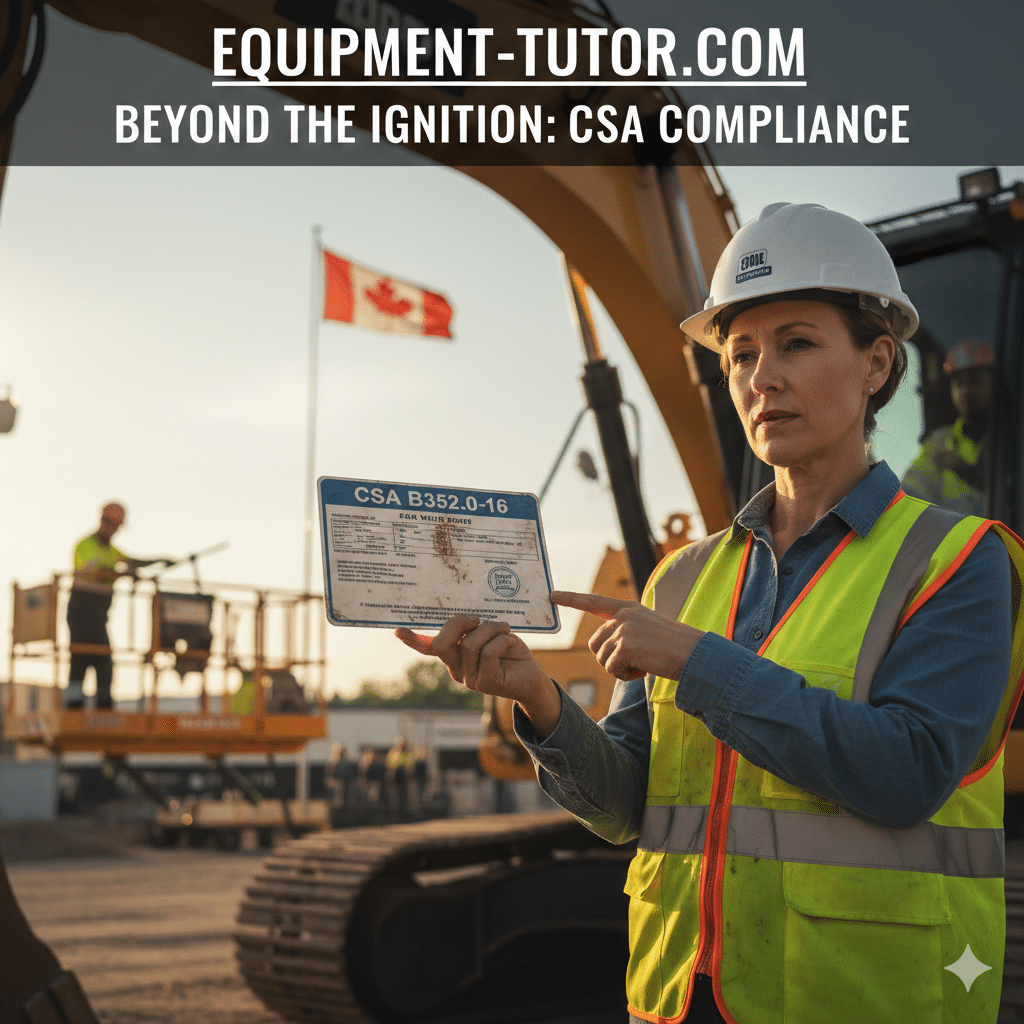
Key Regulation (CSA B352.0-16): This dictates the requirements for Roll-Over Protective Structures (ROPS) and Falling Object Protective Structures (FOPS).
-
The Compliance Plate: Every machine must have a permanent, legible identification plate. If this plate is missing, painted over, or damaged, the machine is technically “out of service” in the eyes of an OHS inspector.
The ROPS/FOPS Non-Negotiable: The “No-Weld” Rule
The most common compliance failure in the field is unauthorized modification.
The Structural Integrity Trap
It is tempting for a shop welder to “stiffen” a cab or weld a bracket for a new light bar onto the ROPS frame. However, any drilling, welding, or cutting of a certified ROPS/FOPS structure voids the certification immediately.
-
The Consequence: Unauthorized modifications render your insurance and OHS compliance null and void.
-
The Solution: Modifications must be accompanied by a Professional Engineer’s (P.Eng) stamp and written approval from the manufacturer.
Load Charts & Data Plates: Legibility is Law
A machine’s capacity is not a suggestion; it is a legal limit. Under CSA Z150 (Cranes) and related provincial Powered Mobile Equipment (PME) regulations, specific visibility requirements apply:
-
Accessibility: The load chart must be available to the operator without them leaving their seat.
-
Legibility: If an inspector finds a load chart that is sun-faded, torn, or in a language the operator doesn’t understand, they can issue a Stop Work Order.
-
Specifics: This includes reach-truck capacities in warehousing and attachment-specific charts for skid steers.
Annual Structural Certifications: The P.Eng Stamp
For high-risk equipment, “regular maintenance” is not enough to satisfy Canadian law.
Equipment Requiring Annual Inspection:
-
Mobile cranes and concrete pumps.
-
Aerial work platforms (MEWPs).
-
Critical excavator components.
These inspections often involve Non-Destructive Testing (NDT)—such as magnetic particle or ultrasonic testing—to find hairline fractures in booms and outriggers that a standard mechanic’s eye might miss.
Quick Reference: Key National Standards
| Standard | Equipment Type |
| CSA B352.0-16 | ROPS and FOPS Structures |
| CSA Z150 | Safety code for mobile cranes |
| CSA B335 | Safety standard for lift trucks |
| CSA C225 | Vehicle-mounted aerial devices |
The Buyer’s & Renter’s Compliance Checklist
Before a machine arrives on your site, ensure you have a “Compliance Package” containing:
-
Current annual inspection certificate (if applicable).
-
The Operator’s Manual (must remain on the machine).
-
Documented maintenance history for the previous 12 months.
-
Verification of all safety decals and warning systems (backup alarms, beacons).
The Missing Link: Turning Compliance into Competency
Understanding engineering standards is only the first step. Ensuring your team can operate within those limits is where the risk truly lies. This is where Equipment-Tutor.com becomes an essential part of your safety management system.
Bridging the Knowledge Gap
Compliance paperwork only protects you if the operator understands the machine’s limitations. Equipment-Tutor.com provides:
-
Interactive Operator Training: Tailored courses ensuring operators can read load charts and identify structural hazards.
-
Maintenance Education: Training for shop teams on “No-Weld” rules and CSA-specific inspection protocols.
-
Documentation Management: A centralized platform to track training certifications, ensuring your “paper trail” is always ready for an OHS auditor.
Don’t wait for an incident to find the gaps in your fleet’s compliance.