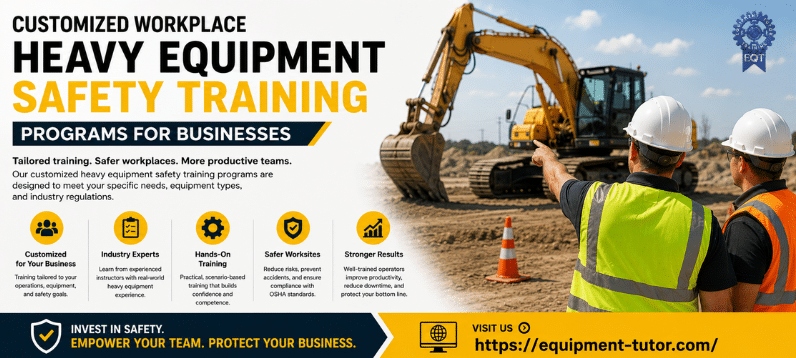
Customized Workplace Heavy Equipment Safety Training Programs for Businesses
Every business that runs heavy equipment carries real risk. Excavators, boom lifts, forklifts, and skid steers keep projects moving. But without proper training, they can also put workers in danger. The solution is not complicated: proper workplace heavy equipment safety training, delivered consistently and tailored to your team. At Equipment Tutor, that is exactly what we build. Read this blog to learn more about the safety training your business needs right now.
Why Generic Safety Training Isn’t Enough
Effective workplace heavy equipment safety training is not just about compliance. It is about building real competence so your operators can recognize hazards, respond correctly, and keep themselves and others safe.
Here is what sets a customized approach apart:
- Training is built around the specific equipment your team uses
- Scenarios reflect your actual job site conditions
- Operators learn in context, not in the abstract
- Your business stays ahead of regulatory requirements
Equipment Operator Training for Beginners
Every skilled operator started somewhere. If your business is hiring new workers or expanding into new equipment categories, starting them off correctly is critical. Equipment operator training for beginners covers the fundamentals every new operator must know before they ever touch a machine:
- How different types of equipment work and what they are used for
- Pre-operation inspection procedures and what to look for
- Safe start-up, operation, and shutdown sequences
- Load limits, stability principles, and tipping hazards
- Communication signals and site protocols
- When to stop and report a concern
At Equipment Tutor, our equipment operator training is designed to be engaging, practical, and self-paced, so new hires can learn without disrupting your entire operations schedule. With 24/7 online access, they can complete modules on their own time and arrive on site ready to work.
Following Heavy Equipment Safety Guidelines Across Your Team
Consistent safety starts with consistent standards. Your team needs to know and follow the same heavy equipment safety guidelines, regardless of experience level or job site location.
These guidelines typically include:
- Pre-shift walkarounds: Inspecting equipment before every use to catch mechanical issues early
- Personal protective equipment (PPE): Ensuring operators wear the right gear for the task
- Spotter communication: Establishing clear signals between operators and ground crews
- Load and lift limits: Never exceeding rated capacities
- Exclusion zones: Keeping unauthorized personnel away from operating equipment
- Fatigue management: Recognizing when an operator is not fit to work
Equipment Maintenance Training
A well-maintained machine is a safer machine. But maintenance often gets pushed aside when project timelines are tight, and that is when breakdowns and incidents happen.
Equipment maintenance training teaches your team how to keep equipment in peak condition, which directly reduces downtime, repair costs, and safety incidents. It is not just for your mechanics. Every operator benefits from understanding how their machine works and what warning signs to watch for.
Our equipment maintenance training at Equipment Tutor covers the following:
- Preventive maintenance schedules and why they matter
- Fluid checks, filters, and wear items operators should inspect daily
- Identifying early signs of mechanical trouble before they become failures
- Proper documentation and reporting procedures
- How to safely tag and take a machine out of service
Equipment Safety Tips That Actually Stick
Classroom theory is useful, but what operators remember on a real job site are the practical equipment safety tips they have applied in context. Here are a few high-impact practices that make a difference on busy sites:
- Always conduct a pre-op inspection: Even when you are under time pressure, a five-minute check can prevent a five-week shutdown.
- Know your blind spots: Different machines have very different visibility profiles. Training should address each type specifically.
- Respect the ground conditions: Slopes, soft ground, and uneven surfaces change how equipment handles. Train operators to read terrain before they move.
- Never assume the machine is fine because it was fine yesterday: Conditions change, equipment wears, and operators need to stay alert.
- Keep communication lines open: Site incidents often happen because someone assumed someone else was watching. Train your team to communicate constantly.
Equipment Operator Certification Training: What Businesses Need to Know
Equipment operator certification training validates that your team members have met a recognized standard of knowledge and competency. For businesses, this is important for several reasons:
- It demonstrates due diligence to regulators and insurers
- It gives clients confidence in your workforce
- It protects your business in the event of an incident investigation
- It supports employee retention by showing that you invest in their growth
Why Businesses Choose Equipment Tutor for Workplace Heavy Equipment Safety Training
Equipment Tutor is a Canadian-owned platform with over 50 years of combined industry experience behind its course development. Our workplace heavy equipment safety training programs are built for businesses. Here is what sets us apart:
- Customized team training: We build programs around your specific equipment, job sites, and team skill levels. No generic content. No wasted time on irrelevant material.
- Flexible online delivery: Our platform is available 24/7 with mobile-friendly access. Your team can train on its schedule without shutting down operations.
- Group purchasing and volume options: We make it easy to train entire workforces at scale, with group purchasing options that work within real business budgets.
- Operator and maintenance pathways: Whether your team needs operator skills, maintenance knowledge, or both, we cover the full picture.
- Trusted by industry partners: Equipment Tutor works with recognized names across Canada’s construction and industrial sectors. Our certifications carry weight because our content reflects real-world standards.
That is why so many Canadian businesses trust us as their go-to partner for workplace heavy equipment safety training.
The Bottom Line
Workplace heavy equipment safety training is not a one-time event. It is an ongoing investment in your people, your equipment, and your business.
If your business runs heavy equipment, your training program should match the demands of the work. Equipment Tutor delivers safety training that is customized, credible, and built to make a real difference on the job site. Contact us today to discuss your team’s training needs.
Frequently Asked Questions :
Q. How is Equipment Tutor’s training different from standard compliance courses?
We build training around the specific equipment, job site conditions, and skill levels of your team so operators retain and apply what they learn. That is what makes our workplace heavy equipment safety training practical, not just procedural.
Q. Can we train an entire team at once?
Yes. We offer group purchasing and team training options specifically for businesses. You can enroll multiple employees, track progress, and manage certifications all in one place.
Q. Is the training suitable for workers with no prior experience?
Absolutely. Our beginner-level courses are designed to bring new operators up to speed efficiently and safely. We cover everything from equipment basics to pre-operation inspections and site protocols.
Q. How does online training work for hands-on equipment operation?
Our online modules cover the knowledge and safety fundamentals operators need before they get on a machine. We combine video lessons, quizzes, and real-world case studies to make learning practical. In-person and practical components can be coordinated based on your needs.
Q. Are the certifications recognized by employers and regulators?
Yes. Equipment Tutor’s certifications are industry-recognized and reflect current Canadian safety standards. They demonstrate that your operators have met a validated level of competency, which supports both compliance and business credibility.